
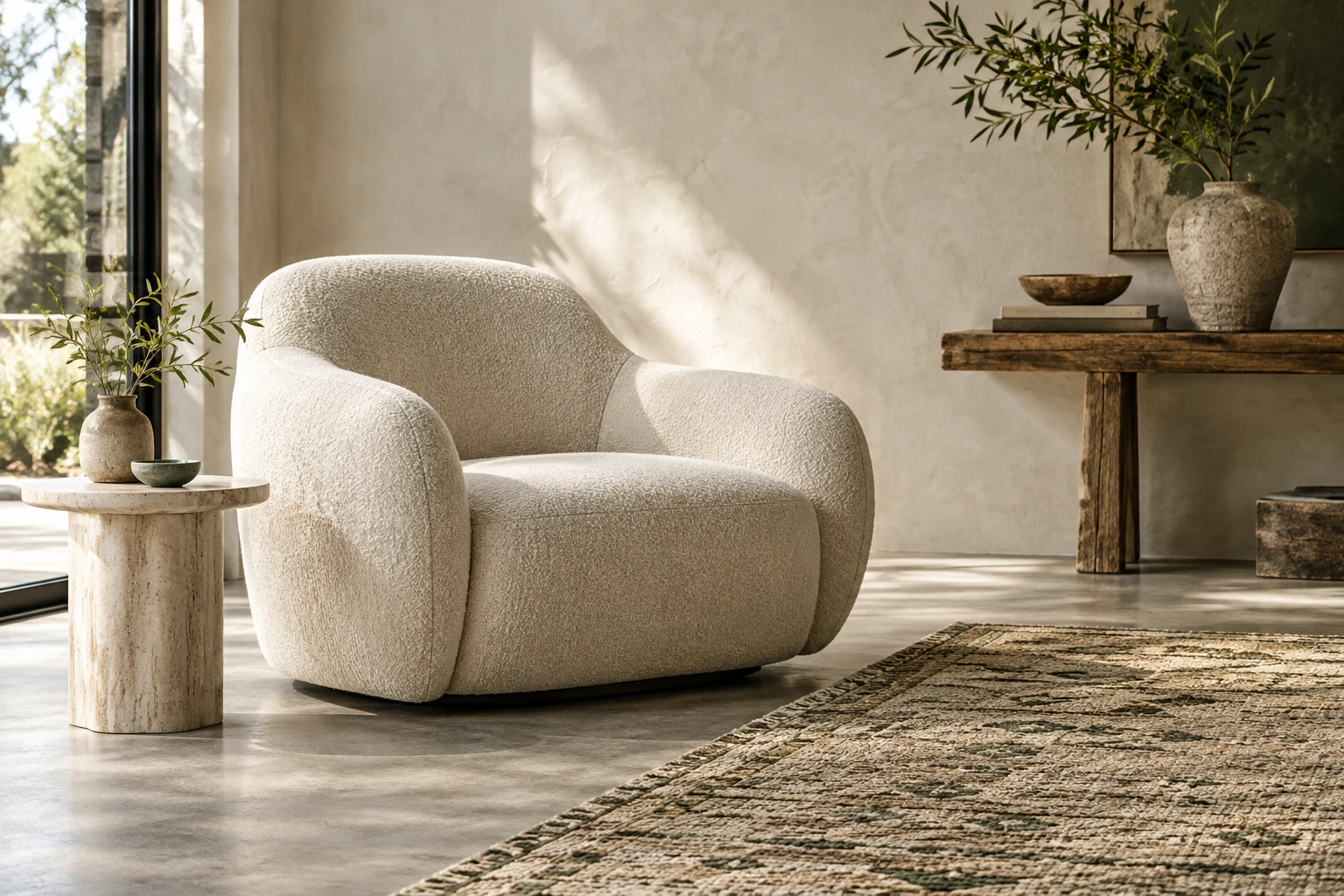
Write the purpose into the brief. Is this a browsing image, a measurement graphic or a comparison at a shared scale? A crop that works well for one may be unsuitable for another.
Choose the image’s purpose first
For individual catalogue images, define a useful framing rule: full product visibility, an agreed amount of surrounding space and a stable baseline. The result can be consistent without pretending every item has the same physical dimensions.
For a size comparison, use verified product dimensions and a controlled method. Cropping isolated source photographs until they “look right” does not establish shared scale, particularly when camera angles differ.
For dimension communication, rely on approved measurements and clearly associated labels. Do not estimate a seat height or table width from its apparent proportions in a photograph.
Preserve geometry during placement
When fitting furniture to a layout, inspect the relationship between legs, arms, backrests and tops. Stretching an object to fill a designated space can change the apparent construction. Scaling should preserve proportions unless a specific correction is supported by reliable reference evidence.
Review the product’s contact with the visual ground. A misplaced base or inconsistent shadow may make an object appear taller or floating, even when the cutout itself remains unchanged.
Keep camera viewpoint in mind. A high-angle dining table photograph exposes more of the top than a low-angle view. Equal image height will not make those photographs directly comparable. A new source angle may be necessary for a comparison set.
Ask two questions at approval
- Browsing set: confirm full visibility, stable placement and the agreed surrounding space. Do not imply a shared physical scale.
- Measurement graphic: check each label against approved dimensions and make its association with the correct part clear.
- Side-by-side comparison: verify both dimensions and source perspectives before using a common scale. Hold the graphic if either remains unresolved.
Ask one question about presentation: does the range share a coherent layout? Ask another about product evidence: do any placement decisions imply a size relationship that has not been verified?
A reviewer should be able to identify which images use independent framing and which, if any, share an established scale. Keep this information with the approved assets so later layouts do not accidentally convert a browsing set into a comparison graphic.
When a browsing set becomes a comparison
Hypothetical example.
A retailer has a compact armchair and a larger lounge chair photographed separately. Each is placed within the same image template with comfortable surrounding space. The images look balanced, but they are not presented as a size comparison.
The marketing team later requests a side-by-side graphic. Instead of reusing the two crops unchanged, the team obtains verified dimensions and checks whether the source perspectives support the intended comparison. Where they do not, the graphic uses explicit measurements or the team commissions aligned photographs.
FAQ
Should every chair occupy the same image height? That can be a reasonable browsing convention if the product remains fully visible. It should not be treated as proof that the chairs are equally tall.
Can a person or household object establish scale? Only if its relationship to the furniture is known and faithfully represented. Adding a stock person or prop does not automatically produce an accurate scale reference.
Include the intended layout and verified dimensions where relevant in your furniture retouching brief.