
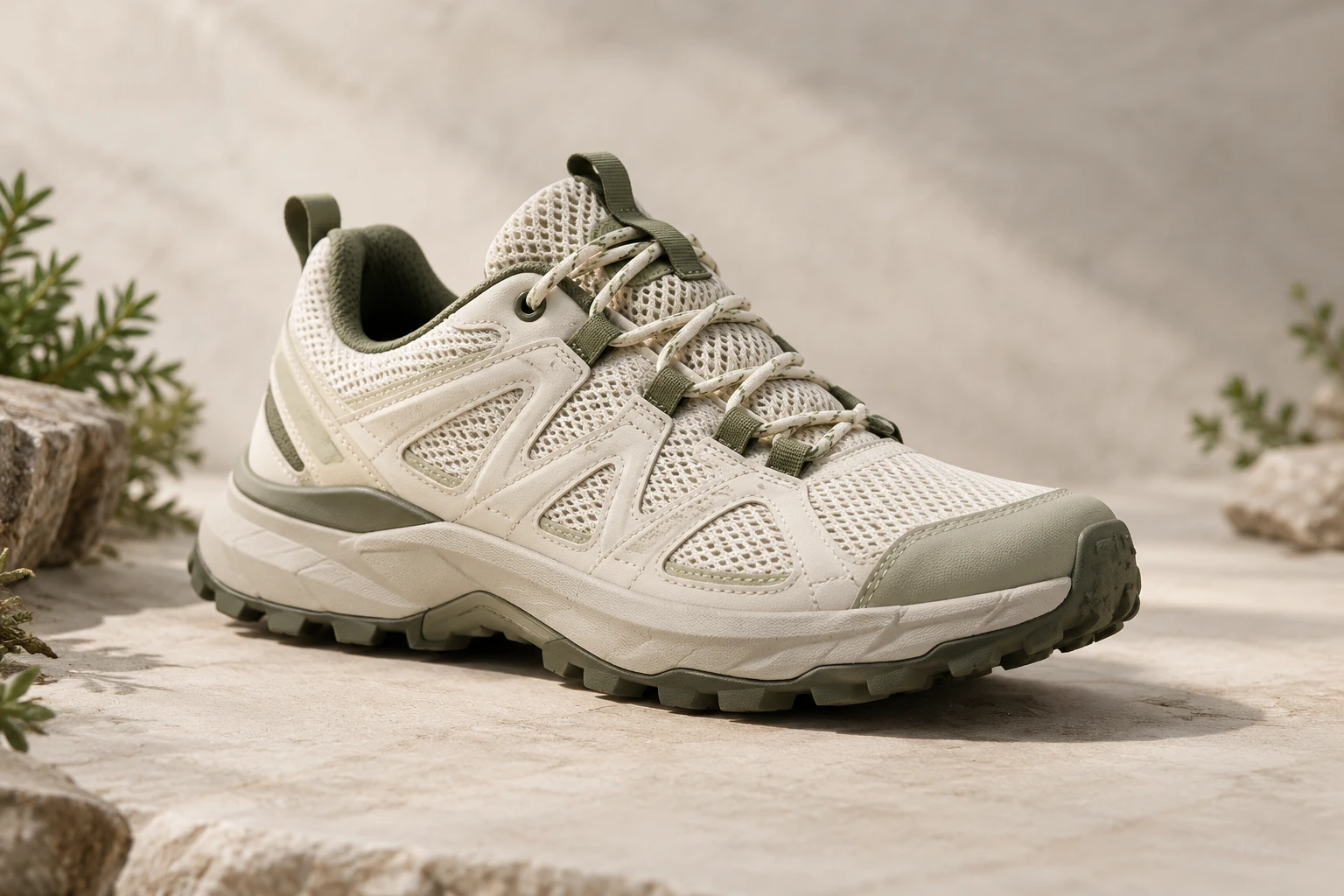
Review the sole, upper and joins separately. Dust may come off a rubber sidewall easily, while a similar-looking mark in the upper could be part of the weave. One cleanup instruction rarely covers both.
Mark the tread, seams and material changes
Before editing, mark the areas that identify the construction: tread pattern, sole edge, seams, perforations, woven openings, adhesive boundaries and any material transitions. This is not a request to exaggerate them. It is a record of what must remain recognisable.
Use a real product reference when a source image is ambiguous. A dark mark beside a seam could be dirt, a shadow or the seam itself. Removing it on appearance alone risks changing the construction.
For a footwear range, identify which details differ between models. A repeated workflow should not make different soles look interchangeable simply because the photographs share an angle.
Separate dirt from texture
Define temporary contamination narrowly. Loose fibres and surface dust may be removable. Grain, knit variation and moulded texture usually belong to the material. A worn sample introduces another decision: whether it adequately represents the item being sold.
Do not ask an editor to convert a visibly worn sole into an imagined new one without a suitable reference. Photograph an appropriate sample or provide verified views of the correct product. Cleanup cannot establish the original shape of missing tread.
Set local expectations. A smooth sole sidewall and a textile upper should not receive identical smoothing. Review whether the edit has reduced the differences between those surfaces.
Inspect the contact points
Check the join between upper and sole, the toe bumper and the heel edge. A tidy cutout can accidentally shave a raised ridge or remove small projections. Compare contours against the source before assessing the background treatment.
Inspect detail at a closer view, then return to the intended delivery size. The first reveals lost construction; the second shows whether sharpening or contrast makes the material look unnatural in normal use.
When dust cleanup removes tread channels
Hypothetical example.
A trail shoe has dust in its outsole grooves and a small fibre across the upper. The brief permits fibre removal and dust cleanup while preserving groove boundaries and mesh openings.
During review, the outsole looks uniformly dark and several shallow grooves have disappeared. Rather than asking for “more texture,” the reviewer points to the missing channels in the source. The revision restores those boundaries without inventing deeper tread or adding a generic texture overlay.
FAQ
Should every tiny mark stay visible? No. Separate incidental contamination from product texture and document uncertain marks. Accuracy does not require retaining removable dust, but it does require protecting material structure.
Can texture from another shoe be copied? Only a verified reference of the same relevant construction could support a specific correction. A visually similar shoe is insufficient evidence of tread, grain or stitching on this product.
Use these construction checkpoints when preparing a footwear retouching brief, with the source and relevant detail views attached.